How to help your child run faster
The How, What, and Why of Running
If there is one certainty in life, it is that children want to run. Running is, after all, the foundation of many physical activities. Running races are also one of the first competitive sports children will play in the school yard.
Children who can will run. However, if your child dreams of running fast and of winning a race, there are plenty of things that you can do to help them realise their goals. Over the next few pages, we’ll look at how to teach your child to run faster with some simple form tips and games you can play at home.
how to Run
When a child is around 18 months old, they will start to experiment with running. That is when they will begin to figure out the ‘how’ of basic running. This is also the start of their development as a runner. This is a development that cannot be rushed; as their coordination and strength evolves, they will be able to move through the phases of running:
🏃♀️ Developmental Phase (ages 2-3). In these early years, toddlers and young children may run with their arms by their sides, or their arms may look ‘stiff’. Their strides are often irregular, which may cause tottering or instability.
🏃♀️ Progressive Phase (ages 3-5). As their bodies and confidence develop, your child will start to swing their arms more powerfully when running. Their strides lengthen and their leg speed increases.
🏃♀️ Speed Phase (ages 4-7). This is the age when running technique starts to develop. Your child will run with bent arms that are kept close to their body. Their stride will lengthen, and they may start to drive forward with their knees.
If you’re unsure how to teach those concepts, don’t worry: we’ve got you covered.

What is Running
Running provides the foundation for competitive sports as varied as soccer, tennis, and gymnastics. It is also a sport in itself. While there are numerous sub-disciplines of running, the sport can be divided into two categories:
🏃♀️ Sprinting: These are the short, fast races. At a professional level, the most common sprint races are the 100m, 200m, and 400m. They are often the most anticipated races at an event like the Olympics, and have made household names out of runners like Usain Bolt, Allyson Felix, and Shelly-Ann Fraser-Pryce.
🏃♀️ Middle and Long Distance: Professional middle-distance racing begins at 800m and includes the 1500m and 3000m. After that, long-distance events begin and progress towards the marathon. Children under the age of 11 should not start training for endurance events as they will run a higher risk of injury.
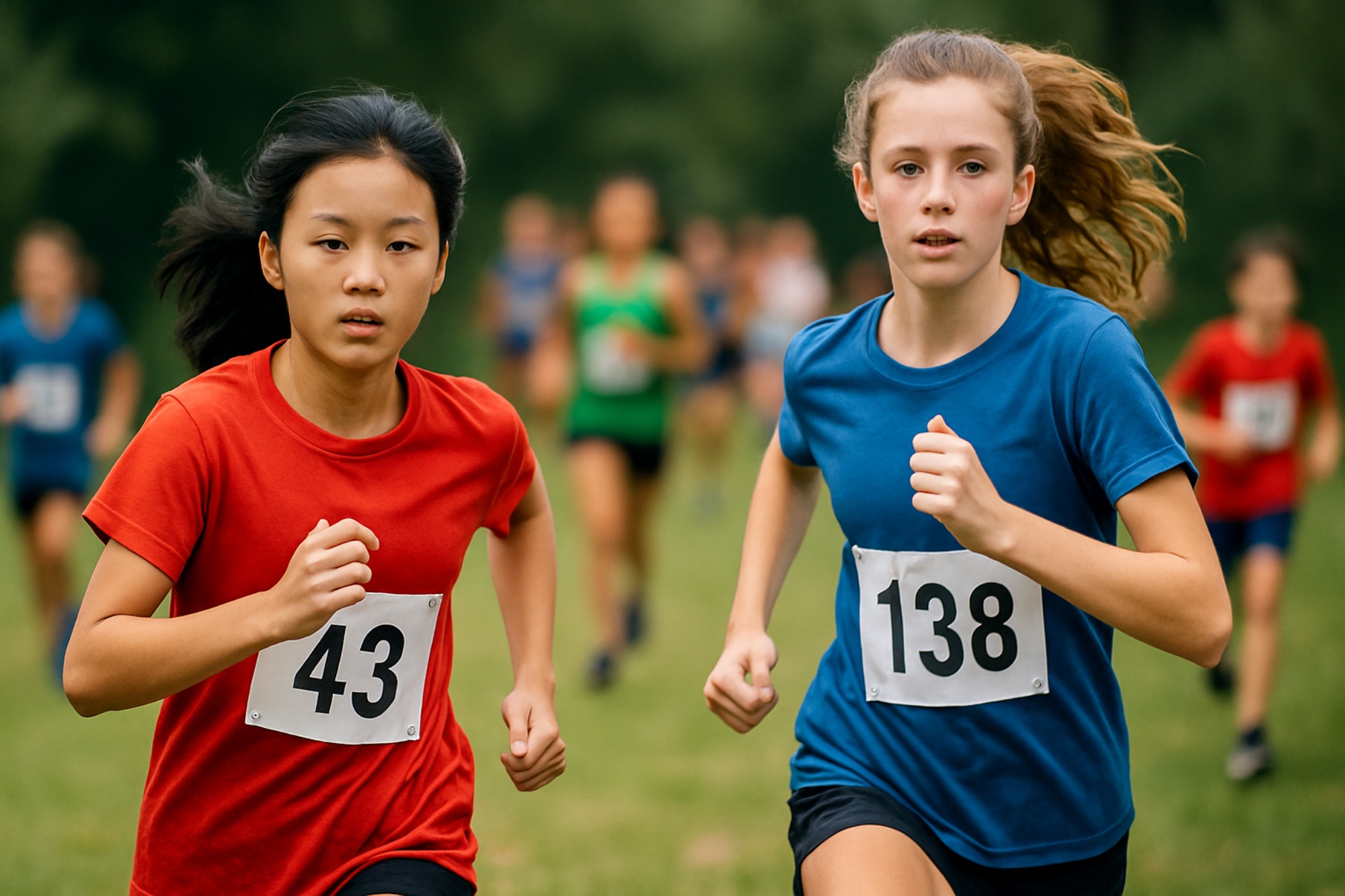
🏃♀️ A note on cross-country: As your child gets older, they may be introduced to cross-country at school. These are typically 3.1 miles / 5km and, as the name suggests, involve running on trails and paths through fields and forests.
Why Get your child into Running?
Running is one of the simplest and most effective ways to keep your child active. It is the foundation for many sports, and is also at the heart of many games that kids naturally want to play. What’s more, as an entry-level sport, it requires minimal investment in equipment and can be practiced almost anywhere.
Skills Your Child Will Learn Running
Strength and Endurance
Coordination
Balance
Focus
Encourages healthy competition
Fun Facts about Running:
🏃♀️ Scientists believe that human beings have been running for nearly 3 million years and that this skill was the key to our evolution.
🏃♀️ The first – and for a long time only – event at the ancient Olympics was the Stade, which was approximately 200 yards / 180 meters. A cook named Coroebus of Elis was the first Olympic champion in the event.
🏃♀️ Jamaican sprinter Usain Bolt holds the world record for the fastest ever 100m. Bolt won the 2009 World Championships in Berlin in a time of 9.58 seconds, reaching a top speed of 27.8mph / 44.72kmh.
More sports
Gymnastics
Gymnastics is fun, easy to start, and great for kids’ strength, balance, and confidence.Basketball
Explore fun, effective basketball drills and training tips for kids and beginners. Help your child build skills, confidence, and love…