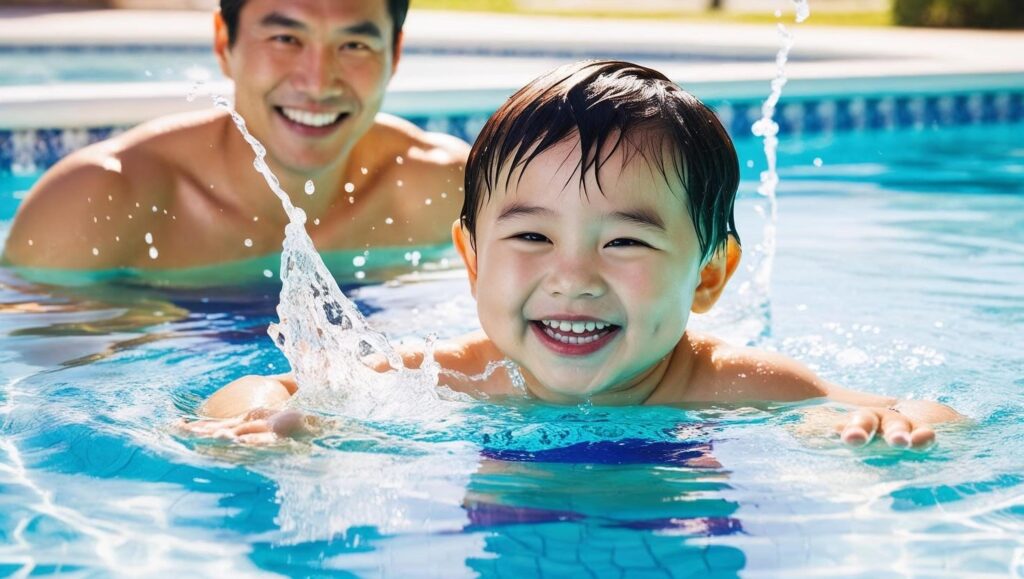
Swimming: Essential skills
Never leave a child unattended near or in water — even for a moment — as it can result in drowning.
Swimming: skills to teach
Swimming is a technique sport; the better your technique, the faster you can swim. However, before we focus on their technique, we need to teach your child some swimming skills to feel comfortable and safe in the water. There are a few foundational water skills that you can teach them to help them achieve that. Remember to always keep it fun, positive, and go at your child’s pace.
Getting into a pool safely
Getting comfortable in the water means teaching your child how to get into the water safely. Most children will learn to swim in a swimming pool, and you should begin your skills instruction by teaching them where and how to enter the pool safely. For instance, they should know the difference between the deep and shallow end and the need to always wait for an adult before getting in.

🏊 Step one – turning onto the tummy: Eventually, your child will want to jump into the pool, but most kids are happy to get in slowly at first. From a sitting position with their legs dangling over the pool’s edge, ask your child to roll over onto their tummy. This ‘slip-in’ entry is the safest way for beginners to enter the water.
🏊 Step two – sliding into the pool: With you holding them, ask your child to slide feet first into the pool. They should hold on to the edge of the pool while they lower themselves in.
🏊 Step three – Practice, practice, practice: Repetition will help reinforce safe entry for your child. Each time you go to the pool, ask them where they should be getting in, and let them show you how to get in safely.
Putting their face in the water
When children are new to the water, putting their faces in can be confronting. To help them overcome any fears they may have, there are a few steps you can take.
🏊 Step one – pouring water on their faces: The act of pouring water over a child’s face can help to remove some of their fears. You can do this in a non-stressful environment, such as a bathtub or paddling pool. It is essential to prepare them first so that the water does not come as a surprise. When they are ready, pour it gently over their hands, arms, shoulders, and head using a cup or a toy watering can. If appropriate, let them do the same to you to show them that it is perfectly normal.

🏊 Step two – kiss the water, then blow bubbles: This will help your child get comfortable putting their face on the water. You can do this in the pool or the bath. Ask them to slowly lower their faces and kiss the water. It’s as simple as that. When they are comfortable doing that, ask them to blow bubbles. Show them how to do it, and challenge them to blow the biggest bubbles that they can. This is a vital skill for learning breath control.
🏊 Step three – dip their face in the water: As they get more comfortable blowing bubbles, ask your child to try dipping their whole face in the water. Agree on a ‘cue’ word before they put their head down; for instance: ‘1,2,3… Dip!’ Make it clear that when you say this they should close their eyes, and hold their breath with their mouth closed. Practice above the water before putting their head in. A cue word is important for the next skill we are going to practice. Keep this exercise short (not even a second) and celebrate every attempt — even a nose underwater deserves a clap.
Going underwater
Safety First! Never submerge a child without eye contact and clear breath cues. Do not do this exercise more than a few times in a session, and stop if your child looks uncomfortable.
When your child is comfortable putting their face into the water, it’s time to teach them to be fully submerged. The important thing is to keep the mood happy and positive, stay with them at all times, and not do this exercise too much at the beginning.
🏊 Step one – preparation: Hold your child under their armpits, facing you. They should be primarily horizontal. Tell them what is going to happen and that you are about to use the cue word.

🏊 Step two – ‘1,2,3… Dip!’ Reinforce the importance of taking a breath and closing their mouth and eyes. When they are ready, ‘1,2,3…Dip’. Gently guide them forward and down through the water, bringing them straight back up to you. They should be submerged for no more than 1-2 seconds. Lift them out of the water and make a fuss of them – they did it!
🏊 Step three – Check in on your child: It’s essential to observe their reaction after this exercise. Initially, they may cough slightly. However, if they look panicked or upset, pause, and try again another day. Don’t be tempted to ‘push through’ – it’s more important that they feel comfortable and trust you.
More sports
Gymnastics
Gymnastics is fun, easy to start, and great for kids’ strength, balance, and confidence.Basketball
Explore fun, effective basketball drills and training tips for kids and beginners. Help your child build skills, confidence, and love…